
The 'green' claims on your website, the labels on your packaging, or that one sustainable word in your product description… Did you think your company was safe with general green slogans? Think again. The European Union will implement a ban on greenwashing from 27 September 2026. This means a game changer for how you communicate about sustainability. Learn which claims you better remove! And discover the steps to prevent fines and reputational damage.
Everyone is against greenwashing. That’s why I certainly recommend being honest in sustainability communication.
And yet the internet and shops are full of unfounded green quotes, slogans, and claims. Until now, this could only lead to reputational damage and complaints.
But from September 2026, the penalties will be significantly heavier. Because from then on, Europe will prohibit greenwashing with a strict directive. And this directive does not only apply to multinationals with a marketing and communications department of twenty people. It applies to you as well, to every SME.
The directive applies to anyone who adds a green and sustainable touch to their communication.
What is greenwashing?
Greenwashing is the green form of brainwashing. Greenwashing is essentially a marketing tactic whereby companies and products present themselves as greener than they actually are.
It involves using green language and imagery that do not correspond with the actual impact.
For example, a small business that writes “CO2-neutral” on its packaging without being able to substantiate that claim is engaging in greenwashing. But also an online shop that uses green icons without any sustainable action behind it falls into that category.
The problem with greenwashing is that it misleads customers and disadvantages honest companies.

Were false claims allowed in communication?
I can only recommend playing it straight. Honesty lasts the longest. And that certainly applies in communication.
But who was not honest? Until now, they risked very little. There was little control over what companies communicated about their sustainability. You could therefore say you were green… until someone sued you.
Thus, in Belgium, among other things, these cases made the media: Flixbus and Brussels Airlines.
FlixBus communicated on its Belgian website with words like “environmentally friendly”, “climate friendly” and “most environmentally friendly mode of transport”. These were vague, unsubstantiated claims, the Federal Public Service Economy found. The company also advertised FlixTrain, although this is not available in Belgium.
FlixBus refused to voluntarily adjust those claims. It communicated even until the final conviction in 2025 with ambiguous environmental claims. Today it substantiates all claims with a comprehensive ESG report.
Brussels Airlines and 16 other airlines communicated about “green” fares, CO₂ neutrality and sustainable aviation fuel. This gave passengers the impression that they could fly “green” or CO₂ neutral for an extra charge.
BEUC and 20+ consumer organisations stated that flying in the short and medium term is by definition not sustainable and complained about the airlines. Today, Brussels Airlines communicates with “fly more sustainably” and “reducing the emissions of your flight”.
Is greenwashing really going to be banned soon?
Yes, greenwashing is really going to be banned soon.
The European Union has approved the “Empowering Consumers for the Green Transition” directive. As is customary, the directive is abbreviated to an acronym: ECGT.
ECGT will come into effect on 27 September 2026.
The ECGT directive is not a soft recommendation. It is legislation that member states must incorporate into their national law. They must also add enforcement and sanctions. Companies that are in violation therefore risk fines and reputational damage.
Do you risk fines for unproven sustainable communication?
Yes, those who do not have the figures behind the green claims in order risk fines. And the fine amounts are extremely high.
Europe imposes a maximum fine of four percent of annual turnover per violation, with 2 million euros as a reference amount. Countries may go higher in their national implementation.
Whether and how Belgium sets its own fine ceiling depends on the national implementation law. We do not know this today.
What can you no longer communicate?
The ECGT now clarifies the boundaries. It determines which claims are allowed and which are not. It also states what evidence you must be able to provide. Only then can you communicate.
The list of prohibited or heavily restricted expressions is longer than many entrepreneurs expect. Here are the main categories:
Vague, unprovable claims
Expressions such as 'environmentally friendly', 'green', 'sustainable', 'eco', or 'natural' are now prohibited unless you can substantiate them with concrete and verifiable data. A nice baseline on your website is not sufficient.
Climate neutrality based on compensation
Compensations no longer count. And that impacts many companies. Because many have communicated until now that they are 'climate neutral' or 'CO2 neutral' because they compensate their emissions by planting trees or purchasing CO2 credits.

The ECGT prohibits the use of compensation as evidence for neutrality. Your own emissions count, period.
Implicit green symbolism
Visual language is also assessed. Green leaves, water droplets, sun symbols, or images of the earth in combination with certain claims are considered an implicit environmental assertion.
If you use those images without substantiation, you are in the danger zone.
Certifications or labels without an recognised certification process
You should best eliminate self-made 'sustainability scores' or non-certified labels. Because only certifications with an independent and transparent verification process count.
Comparisons without context
Saying that your product is '30% more sustainable' than an alternative now requires a clear reference, a measurement method, and a verifiable source.
Why should you adjust your communication today?
From 27 September 2026, all marketing communications must fully comply with the ECGT. This means that products and packaging already on the shelves at that time must also be compliant.
This means you cannot wait until your next print run of brochures or your next website update. Packaging must also be quickly adjusted.
Non-compliant claims on products must be actively corrected in September, for example through stickers or removal from the store.
Adjusting a website, revising packaging, screening marketing materials takes time and preparation.
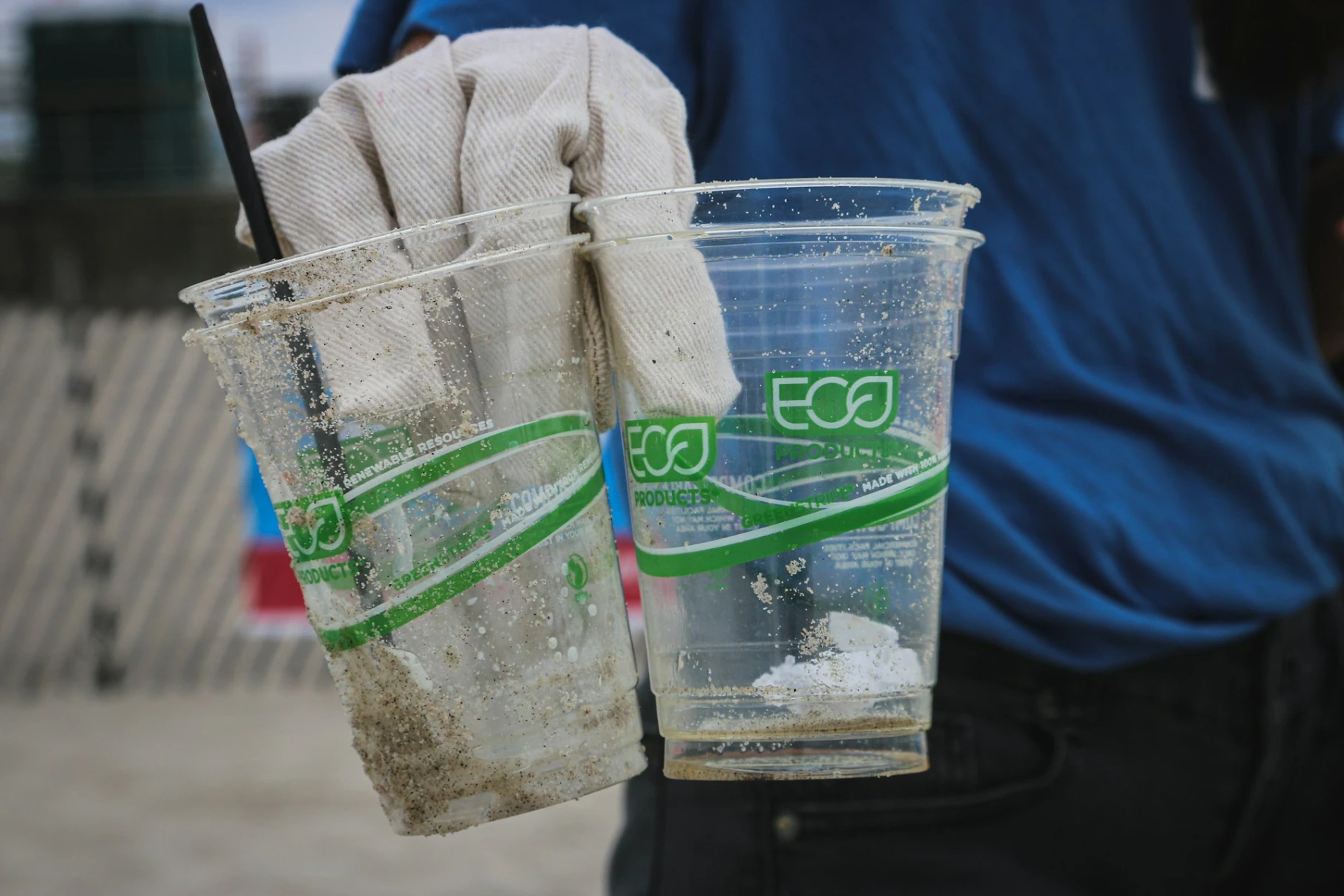
"Eco" with a green leaf on plastic cups? That calls for a solid foundation with figures... or leads to fines.
How do you prevent fines for greenwashing and false claims?
Concrete steps you can take today:
Conduct an audit of your current communication. Review your website, social media, brochures, and packaging. What claims are you making? Can you substantiate them with data?
Measure your CO2 emissions. If you do not know your emissions, you cannot communicate about them. Then set a goal, for example, 0 tons of CO2 by 2050, as the Paris Climate Agreement suggests.
Consolidate all efforts, results, and data on energy, waste, material use… into clear ESG reporting. Use the VSME standard for this. That is the European reporting standard for SMEs.
Link your communication to this ESG reporting. The data forms the legal basis for your future communication.
Do not make compensation claims. Planting trees does not make you a green company. If you are currently communicating that you are neutral thanks to such compensations, adjust that message.
Need help analysing and adjusting your communication? Contact me