Stephen Covey inspireert ook lang na zijn dood C-levels, contentmanagers en hun collega’s bij hun communicatie. Ook ik pas deze principes zelf nog dagelijks toe. Wat ongetwijfeld te danken is aan mijn indrukwekkende en exclusieve interview met de businessgoeroe. Hoe inspireert Stephen Covey vandaag nog C-levels en communicatieprofessionals?
Stephen Covey remains with his book The 7 Habits of Highly Effective People as an unwavering guru at the top of the list of influential thinkers.
Even 7 years after his death, I still often hear my clients and contacts refer to him.
And they are right. Because I do too. Covey also provided useful advice for us as content specialists. In every content strategy I develop, a piece of Covey is guaranteed to sneak in.
Met de 7 habits houdt elke content- en communicatiemanager zichzelf en zijn contentprojecten scherp.
Ultra-efficient content management.
Do you also keep your saw sharp?
Interview with Stephen Covey: "We need humble managers"
Seventy-seven years old was Stephen R. Covey when I interviewed him in 2009. He had never drunk alcohol, used drugs, or smoked.
His daily dose of swimming, cycling, yoga, and praying made him a fit man, with a warm, firm handshake and a pearly white smile.
Okay, I admit. His last speech in Belgium had lost some speed and power.
But I was blown away when I spoke to Stephen Covey during the break of his long keynote.
Because after an hour and a half on stage and another hour and a half in front of the audience, Covey did not let himself slump lazily into the chair. Nor did you see that he was working hard.
No.
In the wings, he underwent a signing and photo session with the people from consultancy FranklinCovey Belgium, which brought him to Belgium. He gave me an exclusive interview for the then magazine Bizz.
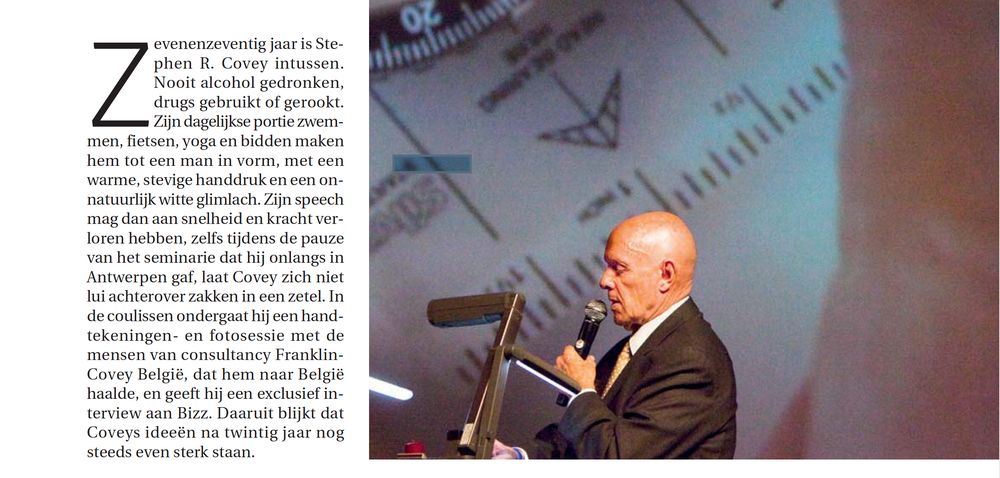
Hans Hermans interviewt managementgoeroe Stephen Covey van The 7 habits of highly effective people (voor Bizz magazine, 2009)
Let's flash back in time.
I conducted this interview in 2009. Two years later, on 16 July 2012, Covey died as a result of a cycling accident. He was 79 years old, father of nine children and grandfather of 52 grandchildren.
Listen along to Covey.
Hans Hermans: The ‘7 Habits of Highly Effective People’ became an unprecedented bestseller, translated into 38 languages. Your publicly listed organisation FranklinCovey offers courses and coaches top managers in 144 countries. Yet the majority of managers still do not act according to Covey's principles. How do you explain that?
Stephen Covey: "Managers have become arrogant, too proud. They build their safety and security on their position. This is because they have been trained in the industrial age where capital was central.
They uphold the supervisory approach and the defensive attitude of that era, with an organisation that revolves around them, in which they are responsible for the results and people are viewed and controlled as a cost."
Flashback in time. The video may look hopelessly old, but the business lessons of Stephen Covey are more than relevant today.
What do managers need to change?
Stephen Covey: "We werken nu al een tijdje in een kennismaatschappij waarin het hoofd, lichaam, hart en ziel van mensen centraal zouden moeten staan.
As a manager, you therefore need to learn a new set of tools and skills.
Dare to unleash the talent in your team and install a culture of trust. Develop complementary teams of people who are self-motivated and collaborate with you as a servant leader. That culture will be responsible for the results.
The certainty you need comes from your integrity and no longer from your power and position.
Admitting mistakes and apologising plays an important role, just like presenting problems to the group instead of imposing your solution. When you achieve results with this, you should definitely let the people above you know.
Habit 1. Be proactive. "Take your responsibility. You and I have the capacity to choose our response."
The era of power and leadership based on positions is over. What authority will replace it?
Stephen Covey: "We kennen een verschuiving van formele naar morele autoriteit, waarin je als manager een cultuur van vertrouwen moet opbouwen.
The keys to this kind of leadership are the quality of their relationships, their integrity, the way they treat people, and their principles. That is what gives them moral authority.
Just look at Nelson Mandela and Mahatma Gandhi.
As a moral leader, you do not impose a solution from management, for example, on how to save costs or how to maintain a good atmosphere after a round of layoffs.
No, you present the problem to your team, after which you leave the meeting or set aside your role as boss. Let them discuss and then come back to listen to their solution.
I will give an example.
A large supermarket chain had a branch where nothing was going well. The staff had no desire to satisfy customers. The store manager had to drive the trolleys back himself and clean the store ...
Until one day they developed a points system.
Each department gave itself points for cleanliness, friendliness, assortment, and so on. Then each department chose the focus area that would have the greatest effect on their score.
They worked on that and held meetings about it with the other departments. In a few months, the business evolved from the worst to the best of 250 supermarkets in the group."
This is the moment to change leadership style, you say. Why?
Stephen Covey: "De competitie die ontstaat door de globalisering versnelt de nood aan ander leiderschap.
Look at what Toyota has done with the American competition. The Toyota culture has wiped out the three car brands GM, Ford, and Chrysler, immediately the biggest business lesson America has ever received.
I was present at a Japanese conference of Toyota with its suppliers.
The company showed all information honestly and clearly. I was very impressed by that complete transparency, it is unprecedented for Americans.
It showed that Toyota and its suppliers are true partners striving for a win-win relationship."
Stephen M. R. Covey builds today on the lessons of Stephen Covey. © FranklinCovey
Is moral action innate or can it be learned?
Stephen Covey: "People who are proactive can change immediately.
It is sometimes difficult, but they are aware of it, have imagination, awareness, and an independent will that allows them to move in a specific direction.
I do it constantly with managers. Or in my own life.
Thus, after nine months of sometimes difficult discussions among our 76 family members, we wrote down a family mission statement. It reads: ‘We serve God by serving others’.
Everyone is responsible for everyone’s loyalty to the mission statement.
For example, I hear from one of my grandchildren that he has tidied up his brother's room, even though he hates that chore.
And even the greatest opponents now have a mission statement for their own family.
We meet weekly to consult with each other. I lead that meeting and encourage them through my moral authority, not by my position as a grandfather.
I still reserve one evening a week for my family to talk about our values and how we live by them."
What is the most difficult aspect of moral leadership?
Stephen Covey: "At the beginning, it is difficult to familiarise people with the new approach.
It takes a lot of humility to learn and a lot of courage to act. Humility and courage together produce integrity.
Discipline is the foundation for success and results. Practising, taking the time, and having patience.
Or how do you think the greatest pianist has played his way to the top?"
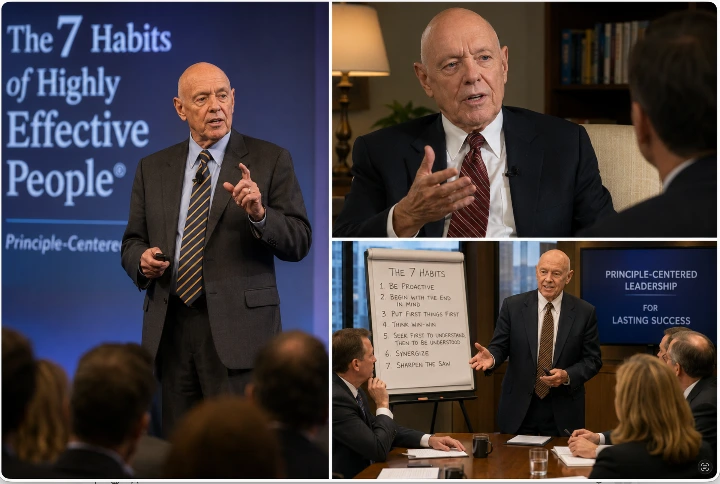
An attempt by ChatGPT to bring the illustrious Stephen R. Covey back to life.
Are you also going to continue with consulting and presentations for so long?
Stephen Covey: "I will go on forever.
I feel it is my purpose to teach principled leadership around the world. I was in Russia yesterday, Belgium today, the Netherlands tomorrow, and then in Great Britain.
At the same time, I am writing new books with new content: The End of Crime, Blessed Are the Peacemakers, and Live Life in Crescendo.
I live according to the principles in this latest book. What I mean to say is: my most important work is still ahead of me."
Who is Stephen R. Covey?
Stephen Covey (1932-2012) is an American who was married for nearly 50 years. He has 9 children and 44 grandchildren. According to Time magazine, he is one of the 25 most influential Americans. He is a Mormon, and that belief is evident in his publications. They are clearly based on traditional Christian ethics.
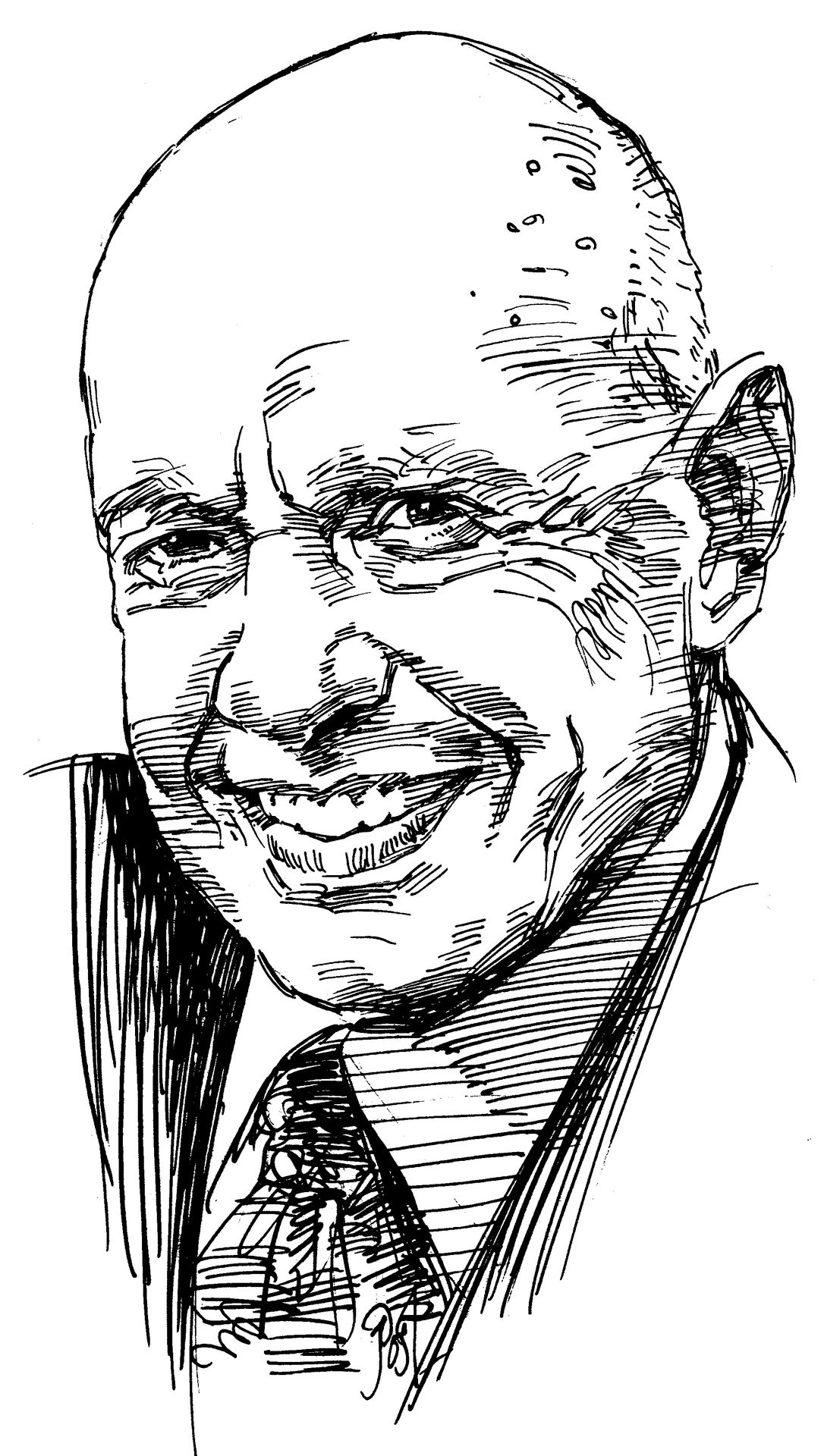
The bald professor of organisational behaviour and business administration has travelled the world for 26 years with The Seven Habits of Highly Effective People.
He has topped the management book lists since 1989. It has been translated into 32 languages, available in 75 countries, and with over 15 million copies sold, it is the best-selling work in its genre.
Stephen Covey's theory actually has everything to NOT become the most popular management theory in the world. While the insights of other gurus focus on stimulating creativity - Tom Peters -, restructuring companies - Michael Hammer - or driving up profits - Michael Porter -, Covey returns to simple laws for social interaction.
He advocates for a reliable and honest interaction with one another. In his thinking, competition is replaced by collaboration.
The goal: to become happier and more successful in business... but certainly also in private life. Covey sees no separation between these two worlds. ‘The 7 Habits’ form the roadmap that should ensure more effective and happier managers.